Matteo Terranini
Dive Director & Co-founder
SSI Instructor Trainer with 15+ years diving the waters of Koh Tao. Matteo has personally logged over 4,000 dives around the island and manages daily dive operations at Carabao Diving.
Published
May 17, 2025
9 min read
Should you start with the Open Water course or go straight to Advanced? Or do both? An honest breakdown of what each course covers, who needs what, and how to decide — from someone who has taught both hundreds of times.
A version of this question lands in my WhatsApp messages every week: "Should I do Open Water or Advanced? Or both?" The answer depends entirely on where you're starting from and what you want to be able to do after you leave Koh Tao. Let me give you the full picture.
I've taught both courses hundreds of times at Carabao Diving. I've seen students skip Open Water and regret it, I've seen experienced divers finally do their Advanced and wonder why they waited so long, and I've seen plenty of people do both back-to-back and leave the island genuinely transformed as divers. The right answer is not the same for everyone — but it's always one of the options below.
What Each Course Actually Covers
SSI Open Water Diver
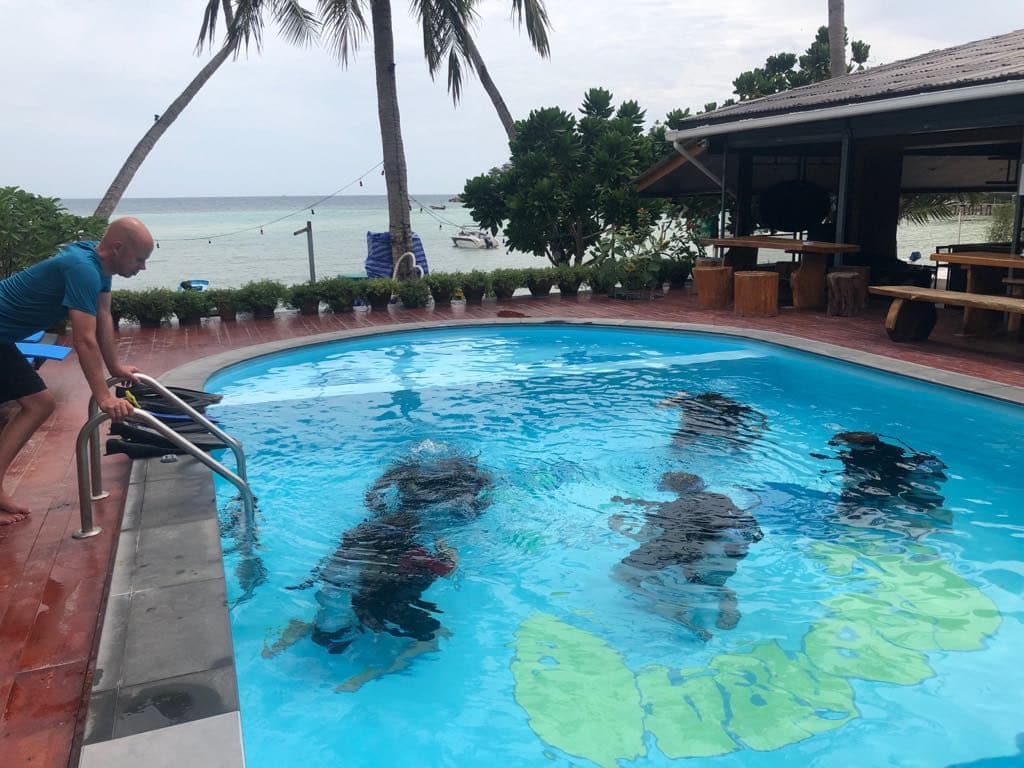
The Open Water course is your entry point into recreational scuba diving. It certifies you to dive independently (with a buddy) to a maximum depth of 18 metres, anywhere in the world. The course is 3–4 days, typically 4 at Carabao. You start with theory — five knowledge development modules covering dive physics, equipment, dive planning, and underwater safety — followed by confined water sessions in the shallows, then four open water dives on real reef sites. By the end, you're a certified diver.
The confined water sessions are where most of the skill work happens: mask clearing, regulator recovery, buoyancy control, controlled ascents, and emergency procedures. These aren't arbitrary exercises — they're the skills that make the difference when something minor goes wrong underwater. We take them seriously, and we don't rush students through them.
SSI Advanced Adventurer
The Advanced Adventurer course is for already-certified divers who want to extend their depth limit to 30 metres and build specific skills. There are no pool sessions — it's five adventure dives in open water, each focusing on a different discipline. Two are mandatory: Deep Diving (taking you to 30m) and Navigation. The remaining three are chosen from a menu of specialties: Peak Performance Buoyancy, Wreck Diving, Night Diving, Drift Diving, Fish Identification, and others.
The course typically takes 2 days. You'll do two dives per day, with a briefing before each and a debrief after. The deep dive is often the one students find most significant — 30 metres is a different world from 18m, and the physical sensations (increased pressure, narcosis at depth) are tangible.
Side-by-Side Comparison
| Open Water Diver | Advanced Adventurer | |
|---|---|---|
| Who it's for | Complete beginners — no experience needed | Already certified Open Water divers |
| Duration | 3–4 days (4 at Carabao) | 2 days |
| Pool / confined water | Yes — 4–5 sessions | No — open water only |
| Open water dives | 4 dives minimum | 5 adventure dives |
| Maximum certified depth | 18 metres | 30 metres |
| Mandatory skills | Full foundational curriculum | Deep + Navigation + 3 chosen specialties |
| Price at Carabao | 9,900 THB | 9,500 THB |
| Combined (both courses) | Discount when booked together | ~7 days total |
| Prerequisites | None (swim ability required) | Open Water certification |
Who Should Do Which Course?
If You've Never Dived Before
Start with Open Water. Full stop. There is no shortcut to the foundational skills — buoyancy, air management, buddy procedures, emergency response. Every advanced skill in the Advanced course assumes you have these dialled in. Rushing into Advanced without an Open Water foundation is asking for a stressful experience underwater.
If You're Already Open Water Certified
The Advanced course opens up a significant portion of Koh Tao's best dive sites — Chumphon Pinnacle, Southwest Pinnacle, the HTMS Sattakut wreck at depth, and Sail Rock properly. If you're already certified and planning more than just a few fun dives, the Advanced course is genuinely worth the time. Two days, five dives, and you come out a meaningfully more capable diver with 30m access.
If You Want to Do Both
Doing both courses back-to-back is probably the most efficient way to make a Koh Tao dive trip count. The combined course takes approximately 6–7 days — Open Water first (4 days), then Advanced straight after (2 days) without a break. You go from zero diving experience to 30m Advanced-certified in one trip. We offer a discount when you book both courses together.
Honest Advice on Back-to-Back
Doing Open Water and Advanced consecutively works well — but don't underestimate the tiredness factor. Six days of diving is physical work. Make sure you're sleeping properly, staying hydrated, and not diving when you're exhausted. The best diving happens when your mind is clear.
What Actually Changes After Your Advanced?
Depth access is the obvious one — 30m vs 18m opens up the majority of serious dive sites globally. But there are less obvious changes too. Your buoyancy improves measurably after five guided dives focused specifically on trim and control. Your air consumption drops as you relax and breathe more efficiently. Your confidence reading a dive site — understanding current, planning your route, navigating without GPS — is genuinely different after the navigation dive.
There's also a practical industry reality: many dive operators around the world, especially for liveaboards and technical diving entry programmes, require Advanced certification to join. An Advanced card broadens what's available to you as a travelling diver significantly.
One Last Thing: Don't Rush
The most common piece of advice I give is this: do Open Water, take a few fun dives to enjoy what you've just learned, and then decide about Advanced. The certifications are tools — they unlock access and build skills. But if you rush through both courses in a week just to have the card and never actually savour any of the diving, you've missed the point entirely.
Ready to Book Your Course?
Whether you're starting with Open Water, upgrading to Advanced, or doing both back-to-back — talk to us directly and we'll help you plan the right schedule for your trip.
Book on WhatsApp❓Frequently Asked Questions
No. The Advanced Adventurer course requires an existing Open Water certification (or equivalent from any recognized agency). It builds directly on the skills and knowledge from Open Water — there are no pool sessions and no foundational skill work. Starting with Advanced without Open Water is not possible.
🎓SSI Certified Instructors · Max 4 Students
Ready to Get Your Diving Certification?
SSI Open Water, Advanced Adventurer, Rescue Diver and more — taught in small groups with beach departure from Sairee, Koh Tao.
You Might Also Like
Open Water Course in Koh Tao: The Complete Guide (What to Expect, Day by Day)
SSI vs PADI in Koh Tao: Which Certification Is Right for You?