Matteo Terranini
Dive Director & Co-founder
SSI Instructor Trainer with 15+ years diving the waters of Koh Tao. Matteo has personally logged over 4,000 dives around the island and manages daily dive operations at Carabao Diving.
Published
April 15, 2026
Updated
May 10, 2026
12 min read
Everything you need to know about the SSI Divemaster course in Koh Tao — cost, duration, prerequisites, what you actually learn, and where it can take your diving career. Written by SSI instructors who trained here and never left.
The SSI Divemaster course is the first step on the professional diving ladder. It's the point where you stop being a recreational diver and start being a dive professional — someone qualified to lead certified divers underwater, assist instructors during courses, and manage dive operations. For many people who do their Open Water course and find themselves hooked, the Divemaster is the natural culmination of that obsession.
At Carabao Diving, we run Divemaster training with the same philosophy we apply to all our courses: small groups, real mentorship, and no shortcuts. If you're thinking about doing your Divemaster in Koh Tao, this guide will tell you exactly what to expect — including the things the course brochures gloss over.
What Is the SSI Divemaster Course?
The SSI Divemaster (DM) certification is the entry-level professional qualification in the SSI system. It sits above Rescue Diver and below Instructor. As an SSI Divemaster, you are certified to lead certified divers on open water dives, assist SSI Instructors with courses, conduct Try Scuba experiences, and teach certain entry-level programs under instructor supervision.
The course is comprehensive. It covers not just the practical skills of leading dives but the theoretical foundation — dive physics, physiology, equipment knowledge, dive site management, and the interpersonal skills needed to handle divers in real-world situations. By the time you complete it, you have a depth of knowledge that transforms how you think about every dive.
What You Learn in the Divemaster Course
Dive Theory
The theory component of the Divemaster course goes significantly deeper than anything covered at recreational level. You'll study the physics of diving (Boyle's Law, Dalton's Law, Henry's Law) in practical detail, understanding not just what the laws say but how they affect a diver's body and behavior underwater. You'll cover physiology — nitrogen narcosis, oxygen toxicity, decompression theory, barotrauma — in enough depth to recognize and manage these situations in the water. You'll also complete a comprehensive equipment module covering how every piece of dive gear works mechanically, how to maintain it, and how to identify faults before they become incidents.
Dive Leading and Underwater Navigation
A core practical skill of the DM course is learning to lead dives properly — which is a completely different skill from just being a good diver. You'll learn how to plan dive profiles, conduct site briefings, read current and conditions, manage a group underwater, maintain spatial awareness of all your divers simultaneously, and navigate back to the exit point reliably. Underwater navigation using compass bearings, natural landmarks, and dive time is trained extensively. By the end, you should be able to lead a group around any known site in Koh Tao without ever losing your orientation.
Stress, Rescue, and Emergency Management
The Divemaster course requires completion of SSI React Right (or equivalent first aid) and builds on that with dive-specific emergency management. You'll practice identifying and managing stressed and panicked divers at the surface and underwater, conducting tired-diver tows, performing in-water rescues, managing unconscious diver scenarios, and administering oxygen. These are not comfortable drills — they're realistic enough that completing them builds genuine confidence. As a DM, you are the first responder in any dive emergency before the instructor or medical help arrives.
Equipment Maintenance
You'll learn to maintain, inspect, and perform basic servicing on the full range of dive equipment: regulators, BCDs, tanks, masks, fins, dive computers, and SMBs. A Divemaster who can identify a failing o-ring or a regulator breathing harder than normal is a Divemaster who prevents incidents before they happen. Equipment knowledge is tested practically — you'll be expected to assemble, inspect, and identify faults in equipment sets under timed conditions.
Conducting Dive Site Briefings
Briefing divers is an art. A good briefing covers the site layout, entry and exit points, depth limits, current and visibility conditions, the dive plan, any hazards, what marine life to expect, and hand signals to use. A poor briefing leaves divers confused, overconfident, or anxious. You'll practice briefing real groups on real Koh Tao dive sites — Japanese Gardens, Twins, Chumphon Pinnacle — with feedback from instructors until your briefings are clear, concise, and useful.
Prerequisites for the Divemaster Course
- Advanced Open Water or SSI Advanced Adventurer certification (or equivalent)
- Rescue Diver certification (SSI Rescue Diver or equivalent)
- SSI React Right or equivalent first aid certification (Emergency First Response, DAN Oxygen Provider)
- Minimum 40 logged dives at application — 60+ dives strongly recommended before starting intensive DM training
- Medical fitness declaration (dive medical form)
- Minimum age: 18 years old
The logged dive requirement is a genuine minimum, not a suggestion. The Divemaster course demands strong buoyancy, confident navigation, and comfort in challenging conditions. If your dive count is low, your DM training will be slower and harder than it needs to be. We recommend candidates arrive with at least 60 dives, including some experience in varied conditions — current, reduced visibility, night diving.
Missing the Rescue Diver certification?
At Carabao Diving, you can complete the SSI Rescue Diver course immediately before beginning the Divemaster programme. Many candidates do Open Water → Advanced Adventurer → Rescue Diver → Divemaster as a full professional pathway. Ask us about the combined package.
How Long Does the Divemaster Course Take?
At Carabao Diving, the Divemaster course typically takes 4 to 8 weeks. The range depends on several factors: your existing dive experience and comfort level, how quickly you master practical skills (particularly rescue scenarios and dive leading), the time you dedicate to theory study, and whether you complete prerequisites before arriving or during the programme.
Candidates with 100+ dives and strong buoyancy often complete the practical components faster. Candidates with 40–60 dives sometimes need additional dive time to build the comfort level required for leading others. We pace the course to the individual — there is no point signing off a Divemaster who isn't ready. A DM certification earned properly in 8 weeks is worth more than one rushed through in 4.
Divemaster Course Cost at Carabao Diving
The SSI Divemaster course at Carabao Diving is priced in the range of 30,000–40,000 THB, depending on your entry point and whether additional dive experience is required before starting the programme.
This fee covers: all SSI digital training materials (DM theory, knowledge reviews, final exam), all dives conducted as part of the DM programme (confined water drills, rescue scenarios, dive leading assessments, skills circuits), SSI certification registration fee, use of all Carabao equipment throughout the programme, and instructor mentorship time. It does not cover accommodation, meals, or any prerequisite courses you may still need (Rescue Diver, React Right).
Accommodation During DM Training
Many DM candidates stay at our beachfront resort during their training, which means you're 30 seconds from the water every morning. We can discuss package accommodation arrangements for the duration of your programme — contact us before you book flights.
Divemaster vs Instructor: What's the Difference?
| Factor | Divemaster | Open Water Instructor |
|---|---|---|
| What you can do | Lead certified divers, assist instructors, conduct Try Scuba | Teach and certify divers from beginner to Advanced |
| Independence | Works under instructor supervision for teaching | Can certify divers independently |
| Depth of theory knowledge | Comprehensive dive physics, physiology, equipment | Full instructor-level theory + teaching methodology |
| Course duration | 4–8 weeks | 10–14 days (IDC) + Instructor Exam, after DM |
| Cost (Koh Tao approx.) | 30,000–40,000 THB | 40,000–60,000 THB (IDC + IE) |
| Required before | Nothing (after Rescue Diver) | Must hold Divemaster first |
| Typical use | Dive guide, DM internship, career foundation | Dive instructor, course director |
The Divemaster is a necessary step before the Instructor Development Course (IDC). You cannot become an SSI Instructor without first holding the Divemaster certification. For most people, the DM course is either a career goal in itself (dive guiding, working on liveaboards) or the first milestone on the path to becoming an instructor.
A Day in the Life of a Divemaster Candidate at Carabao
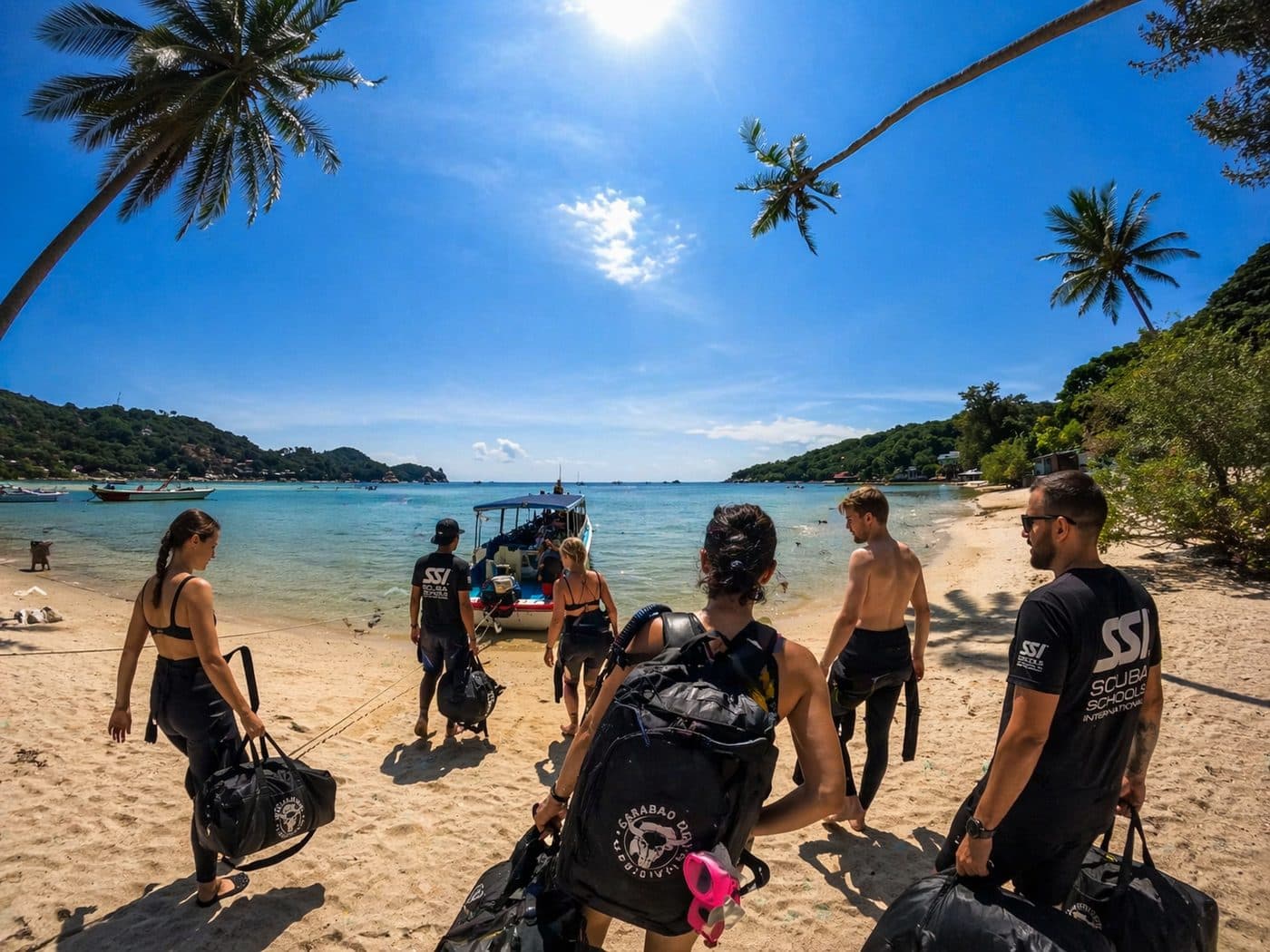
A typical Divemaster training day at Carabao starts early. You're at the dive shop by 7:30 AM, helping prepare equipment for the morning boat trip. You assist the instructors with briefing the day's Open Water students — watching how they structure the brief, what information they emphasize, how they read the group. On the boat, you take responsibility for equipment checks, tank fills, and making sure everyone's gear is assembled correctly before the first dive.
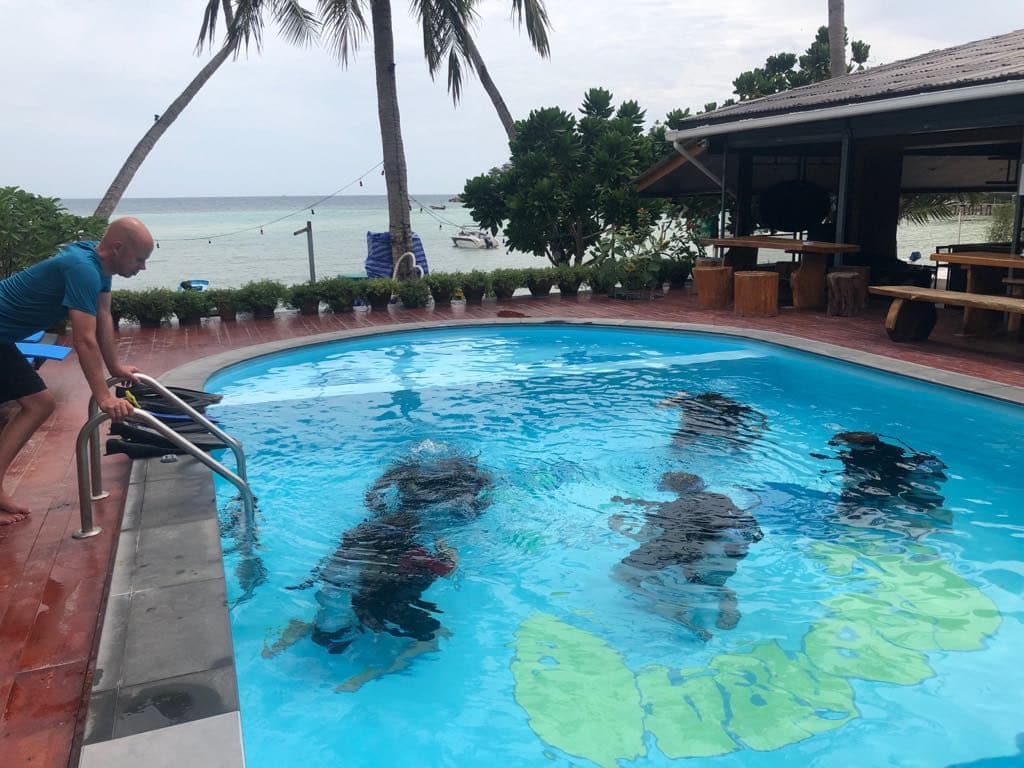
Underwater, you shadow the instructor for the first dive of the week, then progressively take on more responsibility — conducting skills circuits, leading a group through a navigation exercise, managing a mock rescue scenario. After the morning dives, you debrief with your instructor: what went well, what needed adjustment, specific skills to work on. The afternoon might involve theory study for your DM exam, practicing rescue scenarios in the pool, or logging dives independently to build experience. By late afternoon, you've been in or near the water for six to eight hours.
It's immersive. Most DM candidates describe the course as the most intensive learning experience they've had as a diver — not because it's technically brutal, but because you're simultaneously learning new skills, applying them under real conditions, and beginning to develop the awareness and judgment that separates a professional from an enthusiastic recreational diver.
What You Can Do with a Divemaster Certification
The SSI Divemaster opens doors across the diving industry. The most direct opportunity is dive guiding — leading certified divers on fun dives at dive centers in Koh Tao or elsewhere in Southeast Asia. Experienced, reliable DMers are always in demand at reputable dive operations.
Many Divemaster graduates stay on at Carabao or other Koh Tao dive centers as interns — working alongside instructors, building their dive log, and refining their skills while saving toward the Instructor Development Course (IDC). Working as a DM in Koh Tao also means exceptional access to diverse dive conditions: over 25 named sites, seasonal pelagic traffic, and year-round diving. Your dive count will increase faster here than almost anywhere else in the world.
Beyond guiding, a Divemaster certification is recognized by liveaboard operators across the Maldives, Indonesia, the Red Sea, and the Pacific. If you want to combine work with travel, the DM cert is one of the most portable qualifications in adventure tourism. And if becoming an instructor is the eventual goal, the DM is step one — required before the IDC, and the foundation on which your teaching ability will be built.
Why Koh Tao Is Ideal for Divemaster Training
Koh Tao trains more divers per square kilometre than almost anywhere in the world. That density of dive operations means an enormous concentration of experienced instructors, diverse dive sites ranging from 5m training bays to 40m pelagic pinnacles, and a year-round dive calendar. For a Divemaster candidate, this is invaluable: you have constant access to real students, real conditions, and real feedback.
The economics also matter. Cost of living in Koh Tao — food, accommodation, transport — is a fraction of equivalent costs in Australia, Europe, or the Caribbean. Doing a 6-week Divemaster course in Thailand is financially achievable for most people; doing the same course in the Maldives or the Great Barrier Reef is out of reach for many. The dive conditions, meanwhile, are world-class: warm water, excellent visibility for most of the year, and marine life density that makes every training dive an actual dive worth doing.
Start Your Divemaster Journey at Carabao
Interested in the SSI Divemaster course in Koh Tao? Message us on WhatsApp — we'll talk through your current certification level, dive experience, and what the programme timeline looks like for you.
Chat on WhatsApp❓Frequently Asked Questions
At Carabao Diving, the SSI Divemaster course typically takes 4 to 8 weeks. Candidates with more pre-existing dive experience and stronger foundational skills tend to complete it faster. We pace the programme to the individual — there is no fixed end date imposed on the training.
🎓SSI Certified Instructors · Max 4 Students
Ready to Get Your Diving Certification?
SSI Open Water, Advanced Adventurer, Rescue Diver and more — taught in small groups with beach departure from Sairee, Koh Tao.
You Might Also Like
Open Water Course in Koh Tao: The Complete Guide (What to Expect, Day by Day)
SSI vs PADI in Koh Tao: Which Certification Is Right for You?